
1985
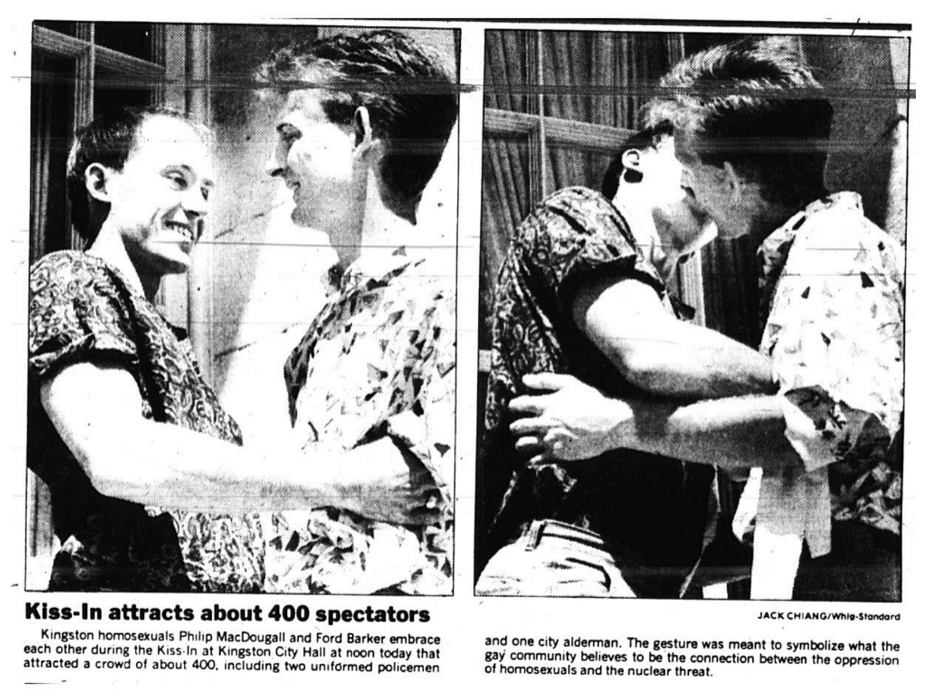
Jack Chiang/Whig-Standard”
August 9th, 1985, marked the 40th anniversary of the Hiroshima and Nagasaki atomic bombings that claimed nearly two hundred thousand lives [1]. Kingstonians joined people all around the world to commemorate the anniversary with candle-lit vigils, and by taking part in anniversary campaigns like the International Shadow Project- where the shadows of deceased Japanese citizens are drawn on the streets to commemorate those whose lives were cruelly taken in the bombing.
But those weren’t the only events Kingston activists wanted to plan. In a response to City Council refusing requests from the queer community to have a gay pride day, as well as refusing requests from nuclear disarmament activists to declare Kingston a “nuclear-free” zone, these two unlikely groups of Kingston activists joined together to plan a controversial gay and lesbian Kiss-In on the steps of City Hall, right on the City Council’s doorstep.
Although the Kiss-In and ceremony itself lasted only fifteen minutes, it attracted over 400 onlookers and was described as “a kiss that reverberated throughout Kingston.” The public’s responses to the kiss varied from curiosity to outrage. While most of the crowd applauded, the event was not met without backlash. Some choose to show their disapproval by booing, while others objected more aggressively and physically. Despite this backlash, organizers hoped that the Kiss-In succeeded in creating space for dialogue on both LGBT issues and disarmament in Kingston [2].
After countless initiatives, campaigns and requests to the City, local queer activists succeeded in convincing the city to hold a Gay and Lesbian Pride. On June 20th, 1992, Kingston’s first Pride Parade marched through Kingston right until City Hall.
The fight for Kingston Pride had a happy ending, but here and all around the world, we still have a long way to go in the fight for queer and trans liberation. In the neoliberal, colonial context of Canada, it is too easy to make queer visibility and representation signifiers of a ‘civilized’ and ‘accepting’ society. However, as this story demonstrates, we understand queer and trans liberation to be inextricably linked with anti-colonial, anti-capitalist, and other radical struggles for autonomy and dignity.
As for the nuclear disarmament campaign, they grew throughout the years in Kingston through the Kingston Peace Council, an organization dedicated to peace and global prosperity, starting with fighting militarization and imperialism in our own backyard.
1. “The Atomic Bombings of Hiroshima and Nagasaki” Atomic Archive
2. McDiarmid, M. E., and Blackbourn, V. ‘ANTI-NUCLEAR “KISS-IN”’, Stones, Retrieved from http://www.stoneskingston.ca/gay-and-lesbian-history/proclamation-of-the-first-gay-and-lesbian-pride-day-in-kingston.